

Birth Chart Interpretation Starts With Accurate Data
Reading a birth chart starts with numbers, not meanings. With the wrong birth time or city, you end up carefully interpreting someone else's chart. So the first step is the boring one, and the one that matters most: getting your data right.
What you need
- Date of birth - day, month and year. This sets which sign each planet is in.
- Exact time - to the minute if you can. The Ascendant moves about one degree every 4 minutes and changes sign roughly every 2 hours, and all 12 houses move with it.
- City of birth - where you were born, not where you live now. It gives the coordinates and the time zone, including daylight saving time, which many countries switched on and off over the decades.
Look for your time on your birth certificate, hospital records or the family baby book. If all you have is "sometime in the morning," you can still cast the chart, but treat the Ascendant and houses with caution: planets in signs will be correct, while the life areas may shift into neighboring houses.
Where to get your chart
The quickest option is the free birth chart calculator on MystarX. It runs on Swiss Ephemeris, sets the time zone from your city automatically, and shows both the wheel and a table with each planet's sign, degree and house. For learning, the table is easier to work with than the drawing.
How the wheel is laid out
The circle is split into 12 slices - the houses. Counting starts at the Ascendant, the line on the left at "nine o'clock," and runs counterclockwise. The top of the chart is the MC, your point of career and reputation, and the bottom is the IC, your roots and home. The symbols inside are planets, and the colored lines between them are aspects. Once you know this layout, the chart stops looking like a secret code.
How to Read a Birth Chart: Start With the Big Three
Beginners tend to read a chart in order, Sun through Pluto, and get lost by planet five. Experienced astrologers start with three anchors instead - the Sun, the Moon and the Ascendant - the foundation everything else sits on.
The Sun - your core
Your Sun sign shows what gives you energy and what your sense of self is built around. The Sun's house shows where you want to shine and be recognized. A Gemini Sun in the 5th house finds itself through creativity and play, while the same Sun in the 6th finds itself through useful work and skill.
The Moon - your needs
The Moon is not about who you want to be, but about what you need to feel safe. How you react under stress, what calms you down, what kind of care you expect from the people close to you. A Moon in Aries wants to let the feeling out fast and move on, while a Moon in Capricorn handles the situation first and feels it later. There is much more in our article on the Moon in your natal chart.
The Ascendant - your way into the world
The Ascendant, or rising sign, is the sign on the eastern horizon at the minute you were born. It describes how you walk into new situations and the first impression you make. There is a practical bonus too: the planet that rules your rising sign is called the chart ruler. Find where it sits, and you have found one of the big themes of your life. Everything about it is in our rising sign guide.
Turning the Big Three into one sentence
Try this formula: "I am [Sun], I need [Moon], and people first see [Ascendant]." For example: "I am drawn to freedom and big horizons (Sun in Sagittarius), I need stability and routine (Moon in Taurus), and I come across as composed and serious (Capricorn rising)." Contradictions are normal - they are what make the portrait feel like a real person instead of a template.
Personal Planets: Mercury, Venus and Mars
After the Big Three, move on to the three fast-moving planets. They change signs within weeks, so they vary a lot even between people born the same year, and they describe your everyday behavior: how you argue, flirt and get things done.
One simple reading rule
Read any placement through three questions: the planet is what (which function), the sign is how (in what style), the house is where (in which area of life). Mars in Virgo in the 10th house is action (Mars), methodical and precise (Virgo), in your career (10th house). This works for every point in the chart.
Mercury - how you think and talk
Your thinking speed, how you explain things, how you learn and decide. Mercury in fire signs grabs ideas instantly and speaks bluntly, in earth signs it thinks things through and likes specifics, in air signs it connects ideas easily and loves to debate, and in water signs it thinks in images and picks up on what is left unsaid.
Venus - what you love and how you get close
Your taste, your values, your relationship with money and pleasure, your love language. Venus in Cancer shows love through care and a cozy home, Venus in Aquarius through friendship and respect for space, and Venus in Scorpio wants all or nothing. It is the key planet for relationships, and we will come back to it at the end.
Mars - how you go after what you want
Energy, desire, how you get angry and how you defend your boundaries. Mars in Leo acts openly and wants its efforts seen, while Mars in Pisces reaches its goals by indirect routes and works best when it believes in the cause. If you cannot work out why you react the way you do in a fight, Mars usually has the answer.
Jupiter and Saturn change signs about once a year and once every 2-3 years, and Uranus, Neptune and Pluto move even slower, so their signs describe a generation more than a person. In your personal reading, their house and their aspects to your Sun, Moon and personal planets matter more.
The 12 Houses: Where Your Story Plays Out
If the planets are the actors and the signs are their costumes, the houses are the stages where the action happens. The twelve houses split life into areas:
- 1st house - appearance, temperament, your approach to life. Starts at the Ascendant.
- 2nd house - money, possessions, self-worth and what you value.
- 3rd house - communication, learning, siblings, neighbors, short trips.
- 4th house - home, family, roots, your inner sense of security. Starts at the IC.
- 5th house - creativity, romance, hobbies, children, anything done for joy.
- 6th house - daily work, habits, health, routines.
- 7th house - partnership, marriage, contracts and open rivals. Starts at the Descendant.
- 8th house - intimacy, shared resources, crises and transformation, psychological depth.
- 9th house - beliefs, higher education, long-distance travel, the search for meaning.
- 10th house - career, status, reputation, long-term goals. Starts at the MC.
- 11th house - friends, communities, like-minded people, plans for the future.
- 12th house - solitude, the unconscious, what is hidden even from yourself.
How to work with the houses
First, notice which houses hold your planets - those are the areas with the most activity and attention in your life. Then look at the sign on each house cusp, the line where the house begins: it describes the style in which you live that area, even if no planets are there. For a full breakdown of every house and the different house systems, read our guide to the astrological houses.
The four angles of the chart - Ascendant, IC, Descendant and MC - are its most sensitive points. A planet within roughly 5-8 degrees of any of them speaks louder than the rest, even if it is a modest Mercury.
Aspects: How the Planets Talk to Each Other
An aspect is the angle between two planets. It shows whether their functions cooperate, clash or merge into one. To start, the five major aspects are enough:
- Conjunction (0°) - two planets act as one. A Sun-Mercury conjunction describes someone whose thoughts and identity are hard to separate.
- Sextile (60°) - a gentle opportunity. It works if you use it and stays quiet if you do not.
- Square (90°) - tension, an inner conflict that pushes you to act. The most driven people almost always have a couple of squares.
- Trine (120°) - easy flow, natural talent. The only risk is taking it for granted and never developing it.
- Opposition (180°) - a seesaw between two poles. The task is not to pick one side, but to learn to hold both.
What an orb is
Aspects are rarely exact to the degree. The allowed margin is called the orb: astrologers usually allow 8-10 degrees for the Sun and Moon and 5-7 for other planets. The tighter the aspect, the stronger it feels. A square with a 1-degree orb is a core theme of your personality, while one with a 7-degree orb is background noise.
Where to begin
List the aspects to your Sun, your Moon and your chart ruler, sort them by how exact they are, and take the top three or four. Those are the main storylines of your chart. How to interpret each planet pair is covered in our detailed guide to natal chart aspects.
What Stands Out: Stelliums, Empty Houses and Elements
Once you have read the basics, step back and look at the chart as a whole. Some things jump out right away, and they are what make one chart different from every other.
Stelliums
Three or more planets in one sign or house. This is a zone of concentration: lots of energy, lots of events and, honestly, some imbalance. A stellium in the 7th house makes partnership a central life theme, and a stellium in Virgo brings a habit of analyzing everything, your own feelings included.
Empty houses
There are ten planets and twelve houses, so everyone has empty houses. An empty 7th house does not mean you will stay single, and an empty 2nd does not mean you will never have money. It means that area runs more quietly, with less drama. To read it, look at the sign on the cusp and at where that sign's ruling planet sits.
Element balance
Count how many personal planets and angles fall in fire, earth, air and water. A strong element is your natural pace, and a missing one is often what you look for in other people. Someone with almost no earth is often drawn to very grounded partners, and that is no accident.
Angular planets and the chart ruler
A planet conjunct the Ascendant or the MC colors the whole personality. Another point to check is the ruler of your Ascendant: its sign, house and aspects. When the Sun and Moon pull in different directions, the chart ruler often explains where a person's life is actually headed.
A Worked Birth Chart Reading
Let's take a sample chart for Emma: Leo rising, Sun, Mercury and Venus in Taurus in the 10th house, Moon in Scorpio in the 4th, Mars in Capricorn in the 6th, Saturn in Aquarius in the 7th. To keep it short, we will use only these points and follow the same steps.
Step 1. The Big Three
Leo rising - Emma walks into a room with warmth and confidence, and people notice her. Sun in Taurus - her core is about stability, taste and following things through. Moon in Scorpio - her feelings are deep and private, and she gives her trust slowly but for keeps. The sentence: "I build things that last, I need depth and loyalty, and people see someone bright and open."
Step 2. The stellium and the chart ruler
Leo is ruled by the Sun, and her Sun sits in the 10th house in a stellium with Mercury and Venus. The main life theme is career and recognition. Taurus and Venus hint at the fields: design, finance, beauty, food, anything that needs taste and patience. Mercury in Taurus speaks slowly but with weight - people listen to her in meetings.
Step 3. The key aspects
The Scorpio Moon opposes the stellium: the 4th house against the 10th, family against career. Emma will feel this seesaw for a long time, and her task is not to choose one side but to find a rhythm where both get their due. Mars in Capricorn trines the Sun, giving stamina and discipline - she can work hard without anyone checking on her. Saturn in Aquarius squares both the Sun and the Moon, forming a T-square, and the tension finds its outlet through the 7th house, meaning through partnership.
Step 4. What stands out
Earth clearly dominates, and there is no fire among the planets at all - only the Ascendant supplies it. That explains the bright exterior with a cautious interior. The action is concentrated on the 4th-10th house axis, while the 5th house is empty. That does not mean no romance - just that casual flirting is not the main storyline, and this house is best read through its ruler.
Step 5. Putting it together
This is someone who builds a career for the long haul, keeps a polished face in public and saves her depth for the people she trusts. For Emma, a relationship is a serious project rather than a fling: Saturn in the 7th often points to an older partner or a later but solid commitment. And this is where one chart is no longer enough - what matters next is her partner's chart.
Common Beginner Mistakes in Birth Chart Interpretation
Most do-it-yourself readings that go wrong trip over the same few stones. Here are the most common ones.
- Reading placements in isolation. "Mars in Cancer, so I am passive" is a conclusion drawn from one puzzle piece. Check the house and aspects first: Mars in Cancer square Uranus can be many things, but passive is not one of them.
- Fearing squares and Saturn. A hard aspect is a growth zone, not a sentence. People with no squares at all often complain that they lack drive.
- Trusting houses with a guessed birth time. If your time is approximate, do not build conclusions on the houses and the Ascendant. Stick to signs and the aspects between planets.
- Mixing house systems. Placidus, Koch and Whole Sign give different cusps. Pick one and do not compare interpretations from different systems, or your planets will keep jumping houses.
- Expecting specific events from the natal chart. Your birth chart describes tendencies and potential, not dates. Timing is the job of transits and progressions.
- Looking for confirmation of your fears. When you read your chart while anxious, your eye catches only the heavy phrases. Write down your strengths as carefully as your challenges.
A good test of a reading: if you recognize yourself in most of it and it helps you understand your own reactions, you are on the right track. If everything sounds like a magazine horoscope, go back to step one and double-check your birth time.
See how your two charts work as a couple
Answer a few questions about yourself and your partner, and get a personal compatibility reading built from both of your birth charts.
Get our compatibility readingNow Compare Your Chart With Your Partner's
Once you can read your own chart, the next question comes naturally: how does it fit with the chart of someone close to you? That is what synastry does - it overlays two charts on top of each other.
The principle is the same as in your personal reading, except the aspects run between the planets of two people:
- Sun and Moon - basic understanding: does one of you feel what the other lives for.
- Venus and Mars - attraction, passion and your style of intimacy.
- Mercury - how easily you talk things through and share a sense of humor.
- Saturn - what makes the bond last and what feels like pressure.
- Your partner's planets in your 7th house - how closely this person matches your picture of a partner.
You can compare two charts in the free compatibility calculator: enter both birth dates, times and cities, and it will show the main aspects between you. And if you would rather have a real reading of your specific couple than a table, take the short quiz below.
Frequently Asked Questions
See how your two charts work as a couple
Answer a few questions about yourself and your partner, and get a personal compatibility reading built from both of your birth charts.
Get our compatibility readingRelated Articles
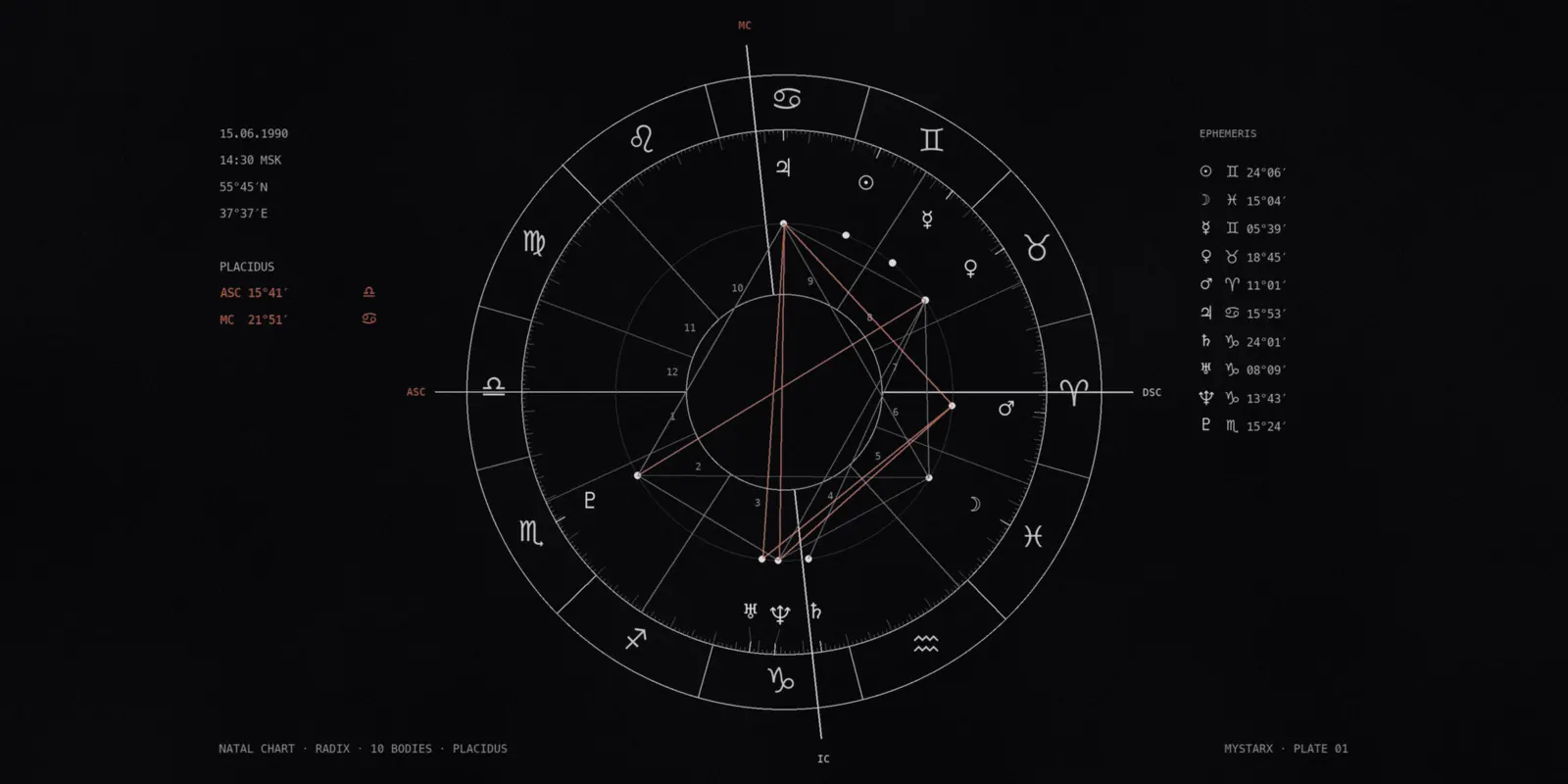
Natal Chart: Complete Beginner's Guide - How to Read Your Birth Chart
What a natal chart is and how to read it: planets, zodiac signs, houses, and aspects. A step-by-step guide for beginners with examples.
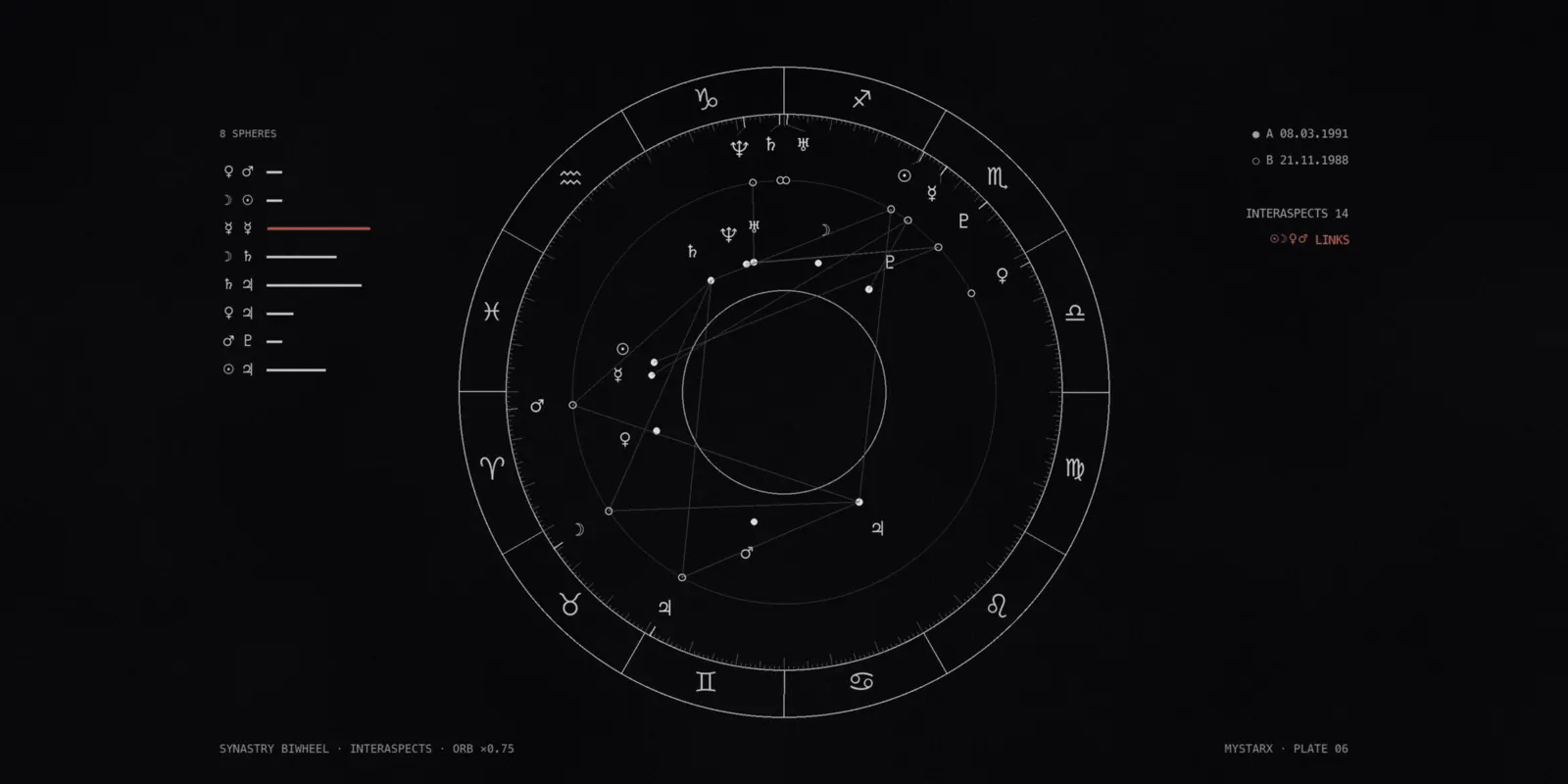
Synastry: 8 Types of Compatibility You Didn't Know About
Learn about 8 types of astrological compatibility: romantic, friendship, business, family, intellectual, sexual, karmic, and overall. Complete synastry guide.
Tarot for Beginners: All 78 Cards Explained Simply
Complete Tarot guide for beginners. Meaning of all 78 Rider-Waite cards: 22 Major Arcana and 56 Minor Arcana explained in plain language.