

Why This Question Is More Complex Than Yes/No
When someone asks "is astrology a science?", a simple answer is expected. Believers shout "yes!", skeptics "no!", and the discussion ends. But reality, as always, is more complex.
Let's examine this honestly, without trying to "sell" you astrology or "debunk" it. Just facts, history, and common sense.
Spoiler: the answer depends on what you call "science" and which aspect of astrology you mean.
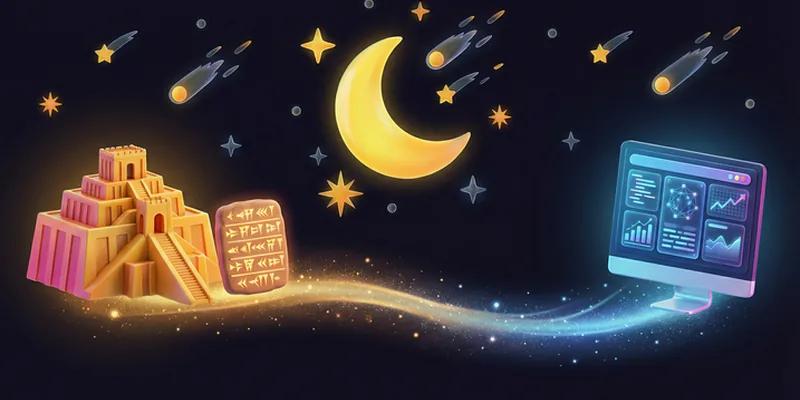
5,000 Years of Observation: From Babylon to Today
- ~3000 BCE - Sumerians and Babylonians begin systematically recording planet positions and linking them to earthly events
- ~500 BCE - Greeks adopt Babylonian astrology, add mathematical systematization. Ptolemy writes "Tetrabiblos"
- Middle Ages - Astrology taught in universities alongside medicine and mathematics. Kepler, Galileo, and Newton studied astrology
- 17th-18th centuries - The "Enlightenment" separates astronomy and astrology
- 20th-21st centuries - Computer technology restores precision to astrology. Swiss Ephemeris and NASA data enable unprecedented accuracy
Fun fact: until the 17th century, astronomy and astrology were ONE discipline. Kepler cast horoscopes to fund his astronomical research.
What in Astrology Is Scientific and What Is Not
Scientific Part: Astronomical Calculations
Natal chart calculation is pure astronomy and mathematics. Planet positions are computed using the same algorithms and data NASA uses. No "mysticism" here - only physics, math, and precise data. This is 100% science.
Debatable Part: Interpretation
The claim "Mars square Saturn means disciplined energy" is interpretation based on millennia of observation but not proven in strict scientific terms.
Honest answer: astrology's interpretive part is closer to humanities (like psychology or sociology) than exact sciences (like physics or chemistry). This doesn't make it "fake" - it makes it a DIFFERENT type of knowledge.
Calculate your natal chart and see astrology's accuracy
Try it nowWhat Research Says
Research "Against"
Shawn Carlson (1985) conducted a double-blind study where astrologers couldn't match natal charts with psychological profiles significantly better than chance.
Research "For"
Michel Gauquelin (1955-1991) found statistically significant correlations between certain planet positions and professions. His "Mars Effect" (athletes more often born with Mars near the horizon) sparked debate but was never convincingly disproven.
What This Means
Science has neither proven nor disproven astrology definitively. The problem is astrology works with very complex systems (the entire natal chart, not one factor), and simple experiments cannot capture this complexity.
Practical Value: What Astrology Actually Gives
Instead of endless "science or not" debates, let's look at practice:
- Self-knowledge - natal charts give surprisingly accurate character descriptions
- Reflection framework - like psychological typologies (MBTI), astrology gives language for discussing yourself and relationships
- Timing - transits provide guideposts for decision-making
- Relationship understanding - synastry helps see couple dynamics objectively
- Comfort and perspective - knowing a "difficult period ends in 3 months" helps endure hardship
Millions worldwide use astrology for self-knowledge and decision-making. Whether it works due to "planetary influence" or as a powerful reflection framework - the result is the same.
Try it yourself
Try it nowMystarX Approach: Precise Data + Expert Interpretation
On MystarX, we use strictly scientific calculations (Swiss Ephemeris, NASA JPL DE441) and professional expertise for interpretation. A combination of precise data and millennia of interpretation experience.
We don't claim astrology predicts the future with absolute certainty. We offer a tool for self-knowledge, relationship understanding, and life period navigation - based on the most accurate data available today.
Try it yourself - calculate a natal chart on MystarX and evaluate how the description resonates with your real experience. That is the best way to answer "does astrology work" - check personally.
Frequently Asked Questions
Related Articles
Swiss Ephemeris and NASA: How Professional Astrologers Calculate Charts
What is behind accurate astrological calculations. Swiss Ephemeris, NASA JPL DE441 data, and why ephemeris quality is critical for an accurate natal chart.
Natal Chart: Complete Beginner's Guide - How to Read Your Birth Chart
Learn what a natal chart is and how to read it. Complete guide to planets, zodiac signs, houses, and aspects. Step-by-step instructions for beginners with examples.
Synastry: 8 Types of Compatibility You Didn't Know About
Learn about 8 types of astrological compatibility: romantic, friendship, business, family, intellectual, sexual, karmic, and overall. Complete synastry guide.