

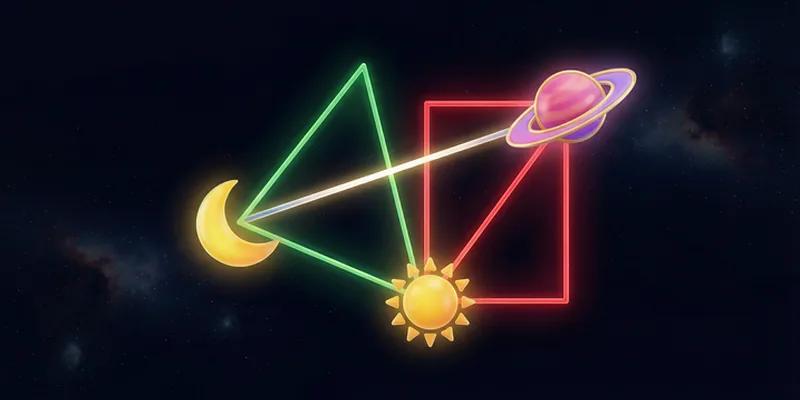
What Are Aspects and Why the Chart Is Meaningless Without Them
Imagine planets as people at a party. Knowing who showed up is one thing. But the interesting part is who's talking to whom, who's arguing, who's ignoring whom. Aspects are exactly these relationships between planets.
Technically, an aspect is the angle between two planets in your natal chart. Depending on the angle, relationships between planets can be harmonious, tense, or neutral.
Without aspects, a natal chart is just a list: "Sun in Aries, Moon in Cancer." With aspects, depth appears: "Sun in Aries trine Jupiter in Sagittarius - you have natural optimism and luck." Feel the difference?
1. Conjunction (0 Degrees) - The Most Powerful Aspect
When two planets stand together (within 8-10 degrees), their energy merges. It's like two people who are constantly together - they influence each other 24/7.
Conjunction is the strongest aspect, and it can be both amazing and challenging:
- Venus + Jupiter - generosity in love, popularity, artistic talents. One of the best aspects
- Sun + Mercury - sharp mind, good speech (very common, as Mercury doesn't stray far from the Sun)
- Mars + Saturn - gas and brakes at the same time. Controlled energy, but also inner conflicts
- Sun + Pluto - powerful personality, drive for power, ability to transform
2. Trine (120 Degrees) - Natural Talent
A trine is like a talent you were born with. Everything comes easily and naturally. Planets in trine support each other without any effort on your part.
- Sun trine Moon - inner harmony, you're at peace with yourself
- Venus trine Mars - natural attractiveness, ease in relationships
- Jupiter trine Sun - luck, optimism, generosity
- Mercury trine Uranus - unconventional thinking, brilliant ideas
But there's a catch: people take easy things for granted. Talent without effort often goes undeveloped. People with lots of trines sometimes achieve less than those with many squares - because squares force you to work.
3. Square (90 Degrees) - The Engine of Growth
Square sounds scary, but it's actually the main driver of your life. When two planets are in a square, there's tension between them - and that tension makes you act.
Common square examples:
- Sun square Saturn - struggles with self-esteem and authority, but overcoming brings real strength
- Moon square Mars - emotional volatility, but also tremendous energy for achieving goals
- Venus square Pluto - intense, transformative relationships. Never boring
- Mercury square Neptune - concentration difficulties, but rich imagination and creative thinking
Main rule: squares are not punishment. They're challenges that make you stronger.
Calculate your natal chart and get a detailed interpretation
Calculate natal chart4. Opposition (180 Degrees) - Balancing Opposites
An opposition is when two planets are on opposite ends of the chart. It's like tug of war: each planet pulls in its own direction.
- Sun opposition Moon - inner conflict between reason and feelings. Common for people born during full moon
- Venus opposition Saturn - desire for love vs fear of vulnerability. Over time you learn to open up
- Mars opposition Jupiter - tendency to do everything at maximum. Need to learn moderation
The key to opposition is finding balance. Don't suppress either side - integrate both.
5. Sextile (60 Degrees) - Opportunities You Need to Use
A sextile is similar to a trine but weaker. It gives opportunities, but you need to actively use them - they won't realize themselves.
If a trine is talent, a sextile is a chance. The door is open, but you need to walk through it.
- Sun sextile Mars - ability for action, but you need to motivate yourself
- Venus sextile Jupiter - opportunities for luck in love and finances
- Mercury sextile Saturn - potential for deep, structured thinking
Minor Aspects: Quincunx, Semi-Square, and Others
Besides the five main ones, there are several more aspects professional astrologers consider:
- Quincunx (150 degrees) - an uncomfortable aspect. Planets don't understand each other and require constant adjustment
- Semi-square (45 degrees) - mild irritation, minor friction
- Sesquiquadrate (135 degrees) - similar to a square but weaker
- Quintile (72 degrees) - a creative aspect, talent for unconventional solutions
Discover what your stars say
Calculate natal chartHow to Read Aspects: Practical Tips
Here's a simple algorithm for beginners:
- Look at exact aspects - the smaller the orb (deviation from exact angle), the stronger the aspect. An aspect with 1-degree orb is more powerful than one with 7 degrees
- Prioritize personal planets - aspects of Sun, Moon, Mercury, Venus, and Mars are felt most strongly
- Don't panic about squares - everyone has them, and without them life would be boring
- Look at the big picture - one square may be softened by a trine from another planet
On MystarX, all aspects are calculated automatically with precise orbs. And if you want to understand what your specific aspects mean - ask your personal astrologer.
Frequently Asked Questions
Discover what your stars say
Calculate your natal chart and get a detailed interpretation
Calculate natal chartRelated Articles
Natal Chart: Complete Beginner's Guide - How to Read Your Birth Chart
Learn what a natal chart is and how to read it. Complete guide to planets, zodiac signs, houses, and aspects. Step-by-step instructions for beginners with examples.
Synastry: 8 Types of Compatibility You Didn't Know About
Learn about 8 types of astrological compatibility: romantic, friendship, business, family, intellectual, sexual, karmic, and overall. Complete synastry guide.
Tarot for Beginners: All 78 Cards Explained Simply
Complete Tarot guide for beginners. Meaning of all 78 Rider-Waite cards: 22 Major Arcana and 56 Minor Arcana explained in plain language.